Though Chianti Classico is Italy’s most famous and exported wine, the king of Tuscan wines is actually a wine I’d bet you’ve never heard of. Vino Nobile di Montepulciano is produced from the local Prugnolo Gentile (Sangiovese) around the hilltop town of Montepulciano, and it is a wine that has been revered throughout history. Vino Nobile di Montepulciano was called a perfect wine by Pope Paul III’s cellarmaster in 1549, was dubbed the king of Tuscan wines (il re dei vini) in the 18th century by Emperor Charles VI, and Voltaire even mentioned the wine in his work Candide.
Thomas Jefferson, the third President of the United States and known wine connoisseur, visited Montepulciano during his stint as U.S. Minister to France in the 1780s. He loved Vino Nobile di Montepulciano so much, Jefferson famously received a shipment of 473 bottles of Montepulciano during his presidency in November 1805. He even wrote a letter to Thomas Appleton proclaiming those bottles of Vino Nobile di Montepulciano the best wine he had ever received.
So just what is this Vino Nobile di Montepulciano that was so beloved throughout history? I headed to the historic Fattoria Svetoni, who has been producing wine since 1865, to find out.
Vino Nobile di Montepulciano DOCG
The Sangiovese grape is the main grape in Chianti Classico, Vino Nobile di Montepulciano and Brunello di Montalcino, but all three wines are very different. Despite their geographic closeness and shared grape ancestry, the wine differ significantly in grape blending rules, aging requirements, style, and price.
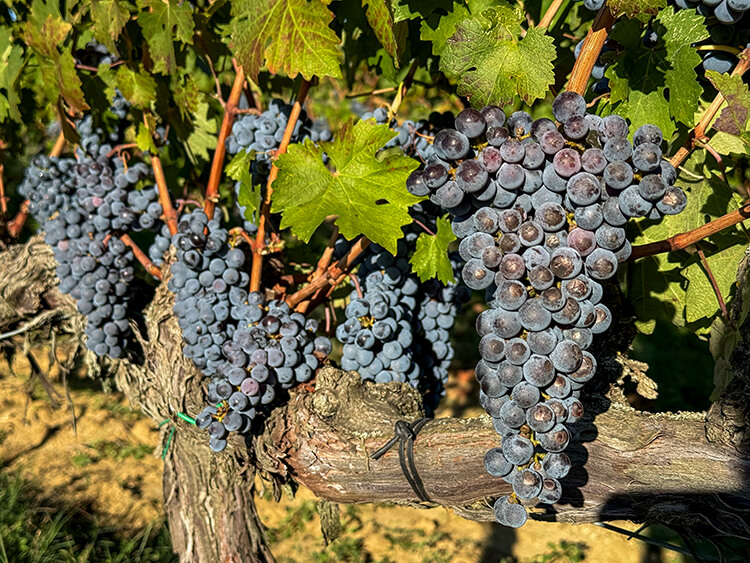
Vino Nobile di Montepulciano is made primarily from Sangiovese grapes (locally called Prugnolo Gentile), but rules allow it to be blended with up to 30% of other permitted grapes varieties such as Canaiolo Nero, Merlot, or Cabernet Sauvignon. Many top Vino Nobile di Montepulciano producers use 100% Sangiovese grapes, though.
Vino Nobile di Montepulciano DOCG regulations require different aging periods depending on whether the wine is a standard release, a Riserva, or a Pieve-designated wine. The aging clock officially begins on January 1st of the year following the harvest. A standard release Vino Nobile di Montepulciano DOCG must spend a minimum of 12 months aging in oak, with another 12 months aging required in either the bottle or in stainless steel before the wine can be released. Vino Nobile di Montepulciano Riserva ages for a minimum total of 3 years before release.
A Pieve-designated Vino Nobile di Montepulciano is the top-tier and highlights only Vino Nobile di Montepulciano producers located in the 12 historic sub-zones (known as Pievi). Additionally, the grapes must come from vineyards at least 15 years old and located at an altitude between 250 and 600 meters above sea level. Finally, the vineyard must also be managed by the winery responsible for bottling the wine. Pieve-designated Vino Nobile di Montepulciano ages for a minimum of 3 years before release.
Though Vino Nobile di Montepulciano is one of the most prestigious Italian red wines often celebrated for its distinct regional character like Barolo and Amarone della Valpolicella, it is also a hidden gem with better everyday value per bottle.
Vino Nobile di Montepulciano should also not be confused with Montepulciano d’Abruzzo, which is an entirely different wine made with the Montepulciano grape in the Abruzzo region.
The History of Fattoria Svetoni
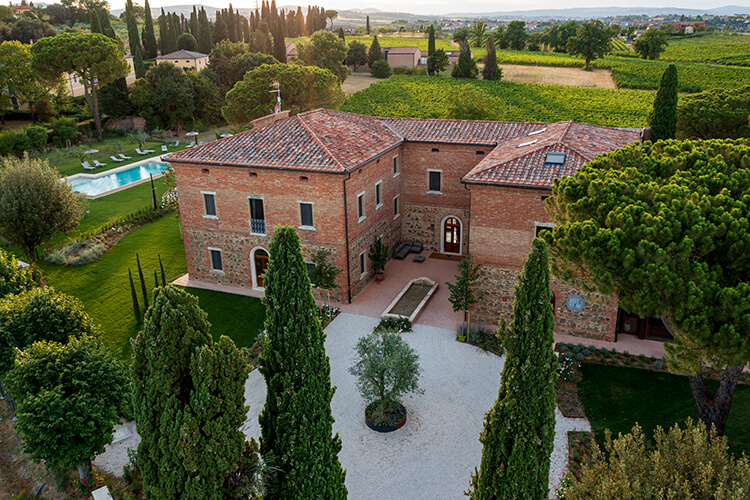
Villa Svetoni was commissioned by Pietro Leopoldo, The Grand Duke of Tuscany and Holy Roman Emperor and.built in the late 1700s. The “farmhouse” is known as the oldest in Montepulciano and a historic remnant from one of Italy’s most well-known “enlightened monarchs.” The Vino Nobile di Montepulciano produced there won an award at the international fair in Turin in 1864, bringing early recognition to the wine estate.
The Svetoni family purchased the estate and took over the wine making activities in 1865, and carried on the tradition for over 150 years.
In the estate’s peak, it spanned roughly 600 hectares with multiple small farms (poderi) supporting hundreds of workers.
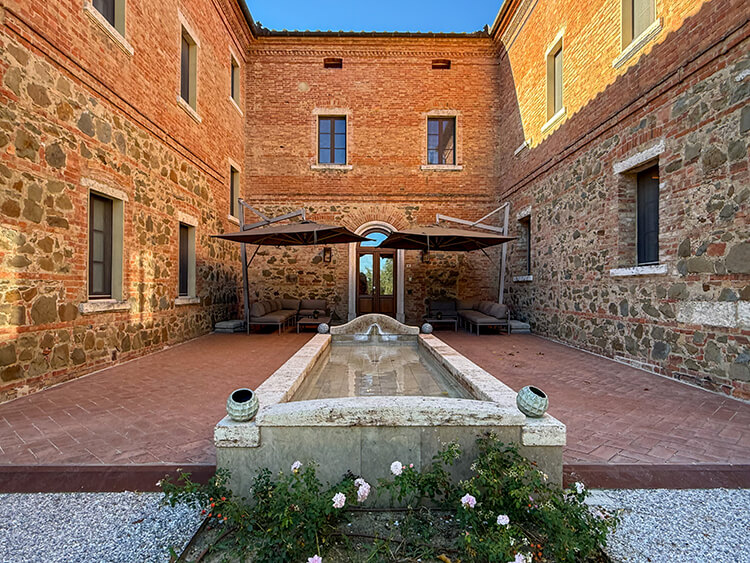
The historic farmhouse and 23 hectares of Sangiovese vineyards were acquired by Podere Rubino Srl, a group of six friends and wine-loving partners. The farmhouse was renovated and transformed into the luxury boutique hotel, spa, and restaurant while continuing to produce Vino Nobile di Montepulciano.
The Wine Tasting Experience at Fattoria Svetoni
Fattoria Svetoni offers several different dog-friendly wine tasting experiences from a classic tour and tasting paired with Italian salumi, or even a wine pairing 3-course lunch in Fattoria Sventoni’s 1 Michelin star restaurant, Osmosi.
As much as I would have loved to try the wine pairing lunch at Osmosi, I was already amply fed from my cooking class with Cook in Tuscany and a dinner of Bistecca Alla Fiorentina awaited Coco and I at Ristorante La Chiusa. So Coco and I joined a small group tour and tasting.
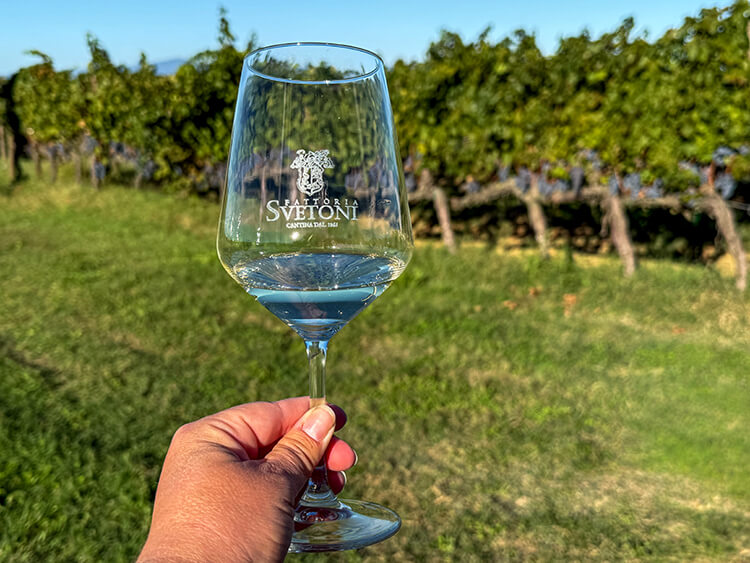
Our visit began with a glass of Fattoria Svetoni Spumante Metodo Classico in hand, which we were invited to take along with us to the vineyard. As we walked toward the vineyard, our guide explained that the Spumante Metodo Classico is a blend of Sangiovese (Prugnolo Gentile), Chardonnay, and Pinot Noir. It is made in the Italian traditional method for making high-quality sparkling wine, identical in technique to the méthode champenoise used in Champagne.
Fattoria Svetoni’s 23 hectares of vineyards were a flurry of harvest activity during our visit. It’s an exciting time in the vineyard with picking the grapes, the tractors transporting the harvested grapes to the winery, and the sorting and pressing happening. We even got to try some of the sweet Prugnolo Gentile straight from the vines as our guide explained that Fattoria Svetoni’s vineyards at an altitude of 300 – 350 meters offer ideal conditions.
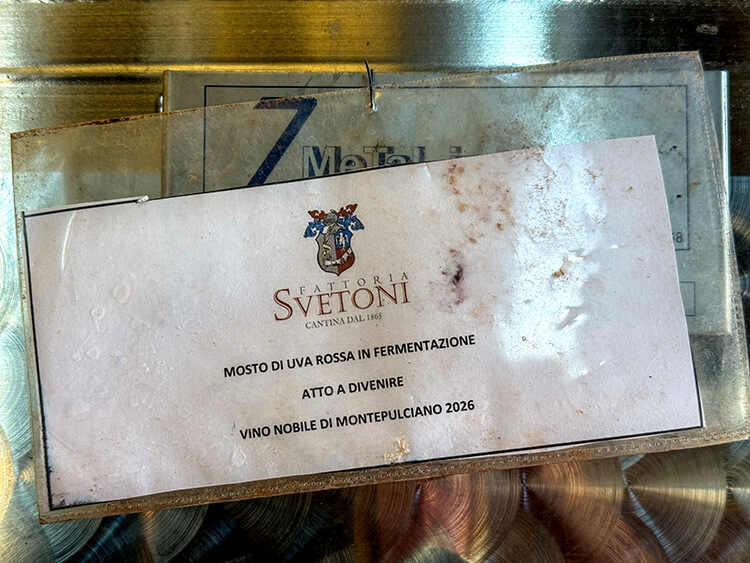
Moving in to the winery, the destemmed and pressed grape must were actively being pumped in to the stainless steel tanks for fermentation.
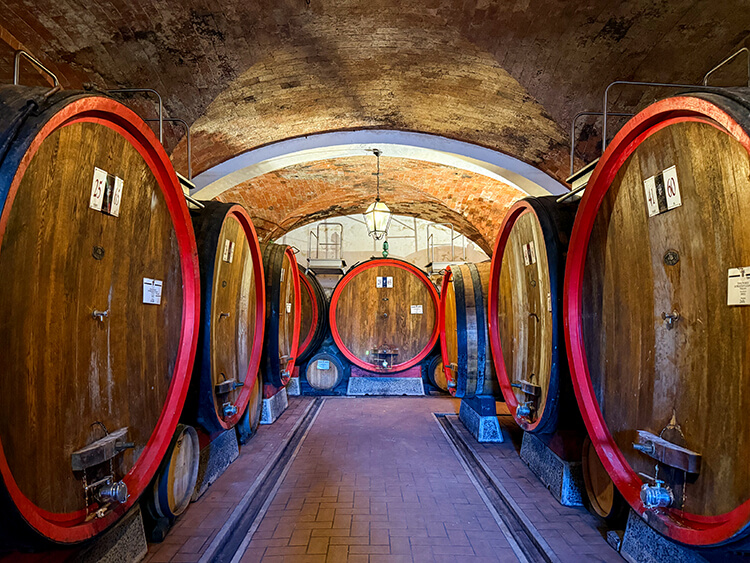
The tour continued to the historic cellar equipped with barriques and large barrels that is located beneath the villa. The centuries-old cellar has been used since 1865 to mature and refine Fattoria Svetoni’s wines.
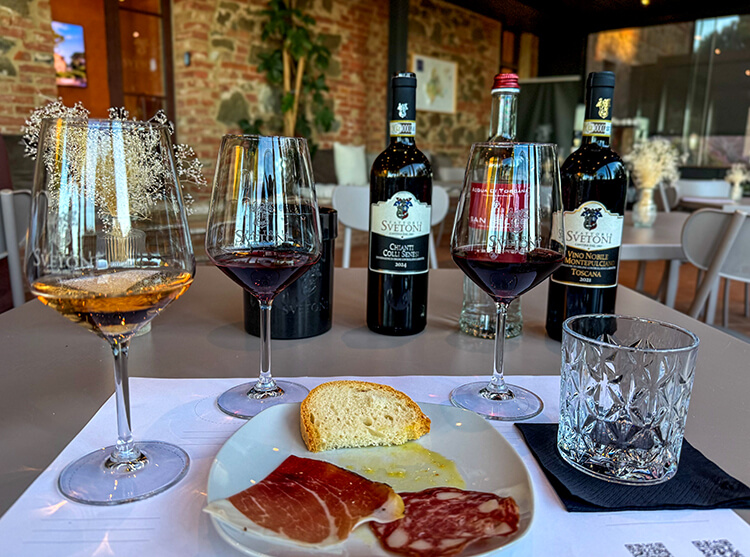
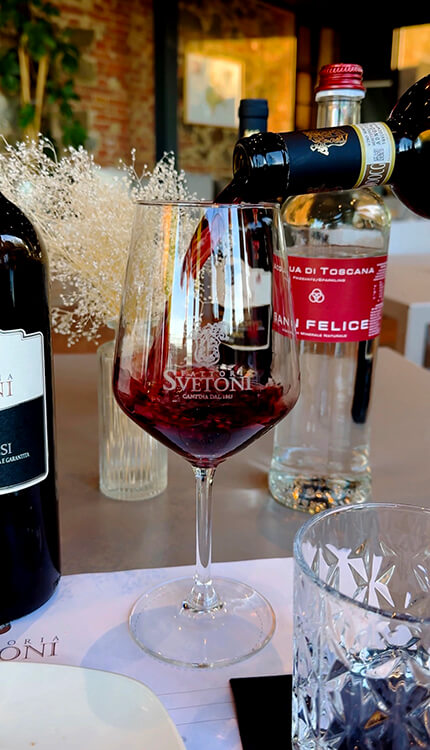
Finally it was time to taste, and a seperate table was set up in the Osmosi restaurant for each couple on our small group tour. The Collection tasting included three wines: the Rosato di Toscana, Chianti Colli Senesi 2024, and Vino Nobile di Montepulciano 2021. Each table also was offered their own bottle of either sparkling or still water, Fattoria Svetoni’s olive oil to taste, and a selection of local salumi to pair with the wine.
As we tasted, our guide explained the grape variety, fermentation and aging process of each wine.
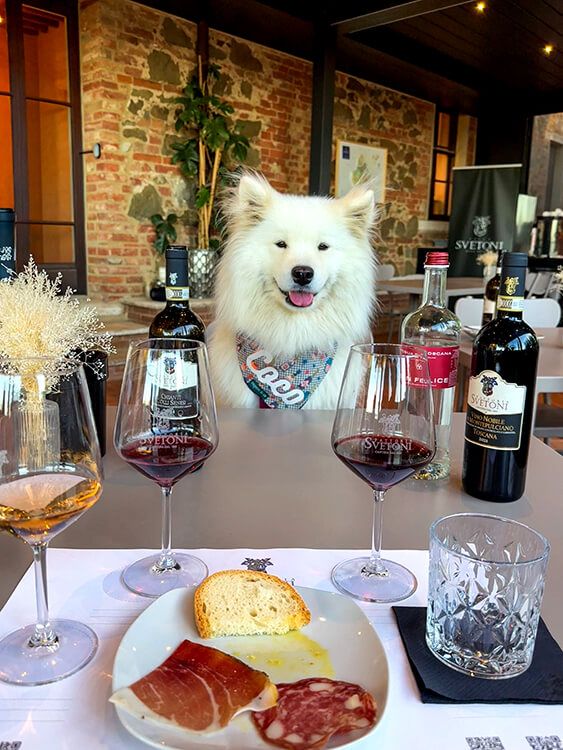
He also explained a bit about Chianti Colli Senesi, which is its’ own DOCG and one of the seven subzones within the Chianti wine region. Chianti Colli Senesi is the second largest of the subzones, after Chianti Classico, stretching as far north as San Gimignano. The subzone also covers the area around the cities of Montalcino and Montepulciano.
The tasting ended just as the sun was beginning to set, turning the skies over the vineyards and olive groves various shades of pink and orange. Truly a perfect way to end an afternoon exploring Montepulciano.
Stay at Villa Svetoni Wine Resort
I did not stay at Villa Svetoni Wine Resort, as Coco and I stayed just a 10 minute drive away at the luxury Agriturismo La Chiusa, but it is also possible to stay at the pet-friendly boutique resort.
Villa Svetoni has 12 elegant rooms in four categories offering large spaces with Tuscan charm and modern amenities. All the rooms have a view, and some rooms also have either a private garden or direct outdoor access, which is perfect for guests traveling with a pet.
Pets stay free of charge, and are offered bowls and a bed for use during your stay. Guests traveling with cats are even offered a litter box during your stay. And dogs are welcome throughout the resort, including on the winery tour and in the 1 Michelin star restaurant.
Guests have access to an onsite spa and can book treatments such as deep tissue massages and facials, a gym, activities like archery, and a pool and jacuzzi nestled near the olive grove (open seasonally from May until mid-October).
Getting to Fattoria Svetoni
Fattoria Svetoni is located around 1.5 hours drive south of Florence. It is best to visit Fattoria Svetoni by car as the area as the Montepulciano countryside is not widely served by trains and public transportation. You can easily rent a car at Florence-Peretola Airport if arriving by flight or from train stations like Firenze Santa Maria Novella or Statzione di Siena. Both train stations have major car rental desks such as Sixt and Hertz.
This article contains affiliate links. When you book on Winalist, Expedia or DiscoverCars through our affiliate sites, we earn a small commission at no additional cost to you.
